Pearson+ LogoPearson+ Logo
Ch. 11 - Cell Communication
Campbell - Campbell Biology 11th Edition
Urry11th EditionCampbell BiologyISBN: 9789357423311Not the one you use?Change textbook
Chapter 11, Problem 5

Apoptosis involves all but which of the following?
a. Fragmentation of the DNA
b. Cell-signaling pathways
c. Lysis of the cell
d. Digestion of cellular contents by scavenger cells

Verified step by step guidance
1
Understand the concept of apoptosis: Apoptosis is a form of programmed cell death that occurs in multicellular organisms. It is a controlled process that allows cells to die without causing harm to the surrounding tissue.
Identify the key features of apoptosis: Apoptosis is characterized by specific cellular changes, including fragmentation of DNA, cell shrinkage, membrane blebbing, and the eventual engulfment of cell fragments by phagocytes.
Analyze each option: a. Fragmentation of the DNA is a hallmark of apoptosis, where the DNA is cleaved into small fragments. b. Cell-signaling pathways are involved in the regulation and execution of apoptosis, ensuring the process is tightly controlled. c. Lysis of the cell is not a feature of apoptosis; instead, it is associated with necrosis, where the cell bursts and releases its contents, causing inflammation. d. Digestion of cellular contents by scavenger cells (phagocytes) is a part of apoptosis, where these cells engulf and break down the apoptotic bodies.
Determine which option does not belong: Since apoptosis is a controlled process that avoids inflammation, the lysis of the cell (option c) is not involved in apoptosis.
Conclude the analysis: The correct answer is that apoptosis does not involve the lysis of the cell, as this would lead to uncontrolled release of cellular contents and potential damage to surrounding tissues.

Verified video answer for a similar problem:

This video solution was recommended by our tutors as helpful for the problem above.
Video duration:
49s
Was this helpful?

Key Concepts

Here are the essential concepts you must grasp in order to answer the question correctly.

Apoptosis

Apoptosis is a programmed cell death process that is crucial for maintaining healthy tissue homeostasis. It involves a series of biochemical events leading to characteristic cell changes and death, including DNA fragmentation, cell shrinkage, and membrane blebbing. Unlike necrosis, apoptosis is a controlled and non-inflammatory process.
Recommended video:
Guided course
04:05
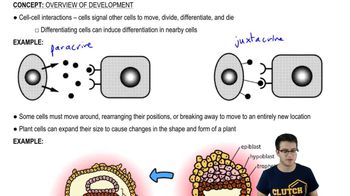
Cellular Interactions and Apoptosis

Cell-Signaling Pathways

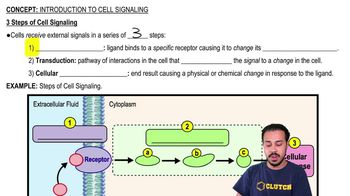
Cell-signaling pathways are systems of communication that govern basic cellular activities and coordinate cell actions. In apoptosis, signaling pathways activate caspases, which are enzymes that execute the cell death program. These pathways ensure that apoptosis occurs in response to specific signals, maintaining balance within tissues.
Recommended video:
Guided course
04:37
3 Steps of Cell Signaling

Lysis of the Cell

Lysis refers to the disintegration or rupture of the cell membrane, leading to cell death. In apoptosis, cell lysis does not occur; instead, the cell undergoes a controlled dismantling process. This is a key distinction from necrosis, where cell lysis results in inflammation and damage to surrounding tissues.
Recommended video:
Guided course
05:33
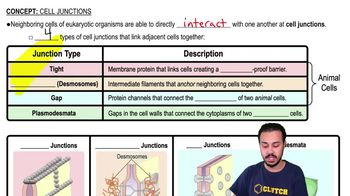
Cell Junctions
Related Practice
Textbook Question

The activation of receptor tyrosine kinases is characterized by

a. Dimerization and phosphorylation

b. Dimerization and IP3 binding.

c. A phosphorylation cascade

d. GTP hydrolysis

1
views
Textbook Question

Lipid-soluble signaling molecules, such as aldosterone, cross the membranes of all cells but affect only target cells because

a. Only target cells retain the appropriate DNA segments.

b. Intracellular receptors are present only in target cells.

c. Only target cells have enzymes that break down aldosterone.

d. Only in target cells is aldosterone able to initiate the phosphorylation cascade that turns genes on.

1
views
Textbook Question

Consider this pathway: epinephrine → G protein-coupled receptor → G protein → adenylyl cyclase → cAMP. Identify the second messenger.

a. cAMP

b. G protein

c. GTP

d. Adenylyl cyclase

1
views
Textbook Question

Which observation suggested to Sutherland the involvement of a second messenger in epinephrine's effect on liver cells?

a. Enzymatic activity was proportional to the amount of calcium added to a cell-free extract.

b. Receptor studies indicated that epinephrine was a ligand.

c. Glycogen breakdown was observed only when epinephrine was administered to intact cells.

d. Glycogen breakdown was observed only when epinephrine and glycogen phosphorylase were mixed.

Textbook Question

Protein phosphorylation is commonly involved with all of the following except

a. Activation of receptor tyrosine kinases

b. Activation of protein kinase molecules

c. Activation of G protein-coupled receptors

d. Regulation of transcription by signaling molecules