Pearson+ LogoPearson+ Logo
Ch. 10 - Photosynthesis
Campbell - Campbell Biology 11th Edition
Urry11th EditionCampbell BiologyISBN: 9789357423311Not the one you use?Change textbook
Chapter 10, Problem 1

The light reactions of photosynthesis supply the Calvin cycle with
a. Light energy.
b. CO2 and ATP.
c. H2O and NADPH.
d. ATP and NADPH.

Verified step by step guidance
1
Understand the two main stages of photosynthesis: the light reactions and the Calvin cycle. The light reactions occur in the thylakoid membranes of chloroplasts and convert solar energy into chemical energy.
Recognize that the light reactions produce ATP and NADPH, which are energy carriers. These molecules are essential for the Calvin cycle, which occurs in the stroma of chloroplasts.
Recall that the Calvin cycle uses ATP and NADPH to convert carbon dioxide ( CO 2 ) into glucose, a process known as carbon fixation.
Identify that light energy is not directly supplied to the Calvin cycle; instead, it is used in the light reactions to generate ATP and NADPH.
Conclude that the correct answer is d. ATP and NADPH, as these are the products of the light reactions that are utilized in the Calvin cycle.

Verified video answer for a similar problem:

This video solution was recommended by our tutors as helpful for the problem above.
Video duration:
1m
Was this helpful?

Key Concepts

Here are the essential concepts you must grasp in order to answer the question correctly.

Photosynthesis

Photosynthesis is the process by which green plants, algae, and some bacteria convert light energy into chemical energy stored in glucose. It consists of two main stages: the light-dependent reactions and the Calvin cycle. The light-dependent reactions capture sunlight to produce ATP and NADPH, which are then used in the Calvin cycle to synthesize glucose from CO2.
Recommended video:
Guided course
05:58
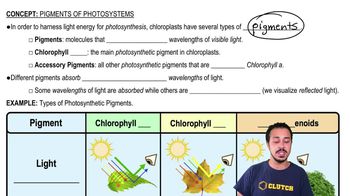
Pigments of Photosynthesis

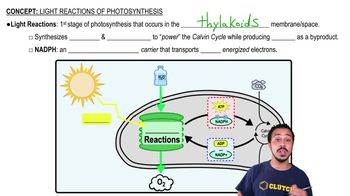
Light-dependent Reactions

The light-dependent reactions occur in the thylakoid membranes of chloroplasts where sunlight is absorbed by chlorophyll. This energy is used to split water molecules, releasing oxygen, and to generate ATP and NADPH. These products are essential for the Calvin cycle, providing the energy and reducing power needed to convert CO2 into glucose.
Recommended video:
Guided course
04:06
Light Reactions of Photosynthesis

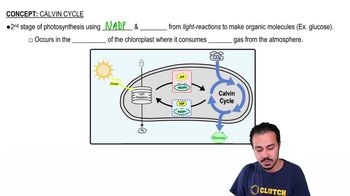
Calvin Cycle

The Calvin cycle, also known as the light-independent reactions, takes place in the stroma of chloroplasts. It uses ATP and NADPH produced in the light-dependent reactions to convert CO2 into glucose through a series of enzyme-mediated steps. This cycle does not require light directly but relies on the energy carriers generated during the light-dependent phase.
Recommended video: