Pearson+ LogoPearson+ Logo
Ch. 8 - Does Testing Save Lives?
Belk, Maier - Biology: Science for Life 6th Edition
Belk, Maier6th EditionBiology: Science for LifeISBN: 9780135214084Not the one you use?Change textbook
Chapter 8, Problem 2

Add labels to the figure that follows, which illustrates a portion of the human life cycle.
Illustration of human life cycle stages: sperm, egg, zygote, and embryo development.

Verified step by step guidance
1
Identify the male and female figures in the image as representing the human reproductive system. Label them as 'Male' and 'Female' respectively.
Label the structure released by the male as 'Sperm' and the structure released by the female as 'Egg' or 'Ovum'.
Label the fusion of the sperm and egg as 'Fertilization', which results in the formation of a zygote.
Label the single-celled zygote as 'Zygote', which undergoes cell division (cleavage).
Label the multicellular structure formed after several rounds of cell division as 'Blastocyst', which is an early stage of embryonic development.

Verified video answer for a similar problem:

This video solution was recommended by our tutors as helpful for the problem above.
Video duration:
3m
Was this helpful?

Key Concepts

Here are the essential concepts you must grasp in order to answer the question correctly.

Human Reproductive Cells

Human reproduction begins with the fusion of gametes, which are specialized reproductive cells: sperm from males and eggs from females. Sperm are motile cells that travel to fertilize the egg, while eggs are larger and contain nutrients necessary for early development. Understanding the structure and function of these cells is crucial for grasping the initial stages of the human life cycle.
Recommended video:
Guided course
02:58
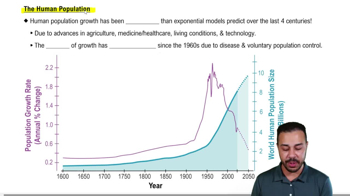
The Human Population

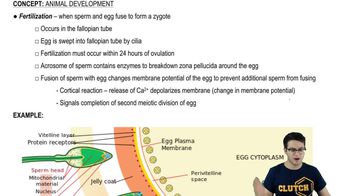
Fertilization

Fertilization is the process where a sperm cell successfully penetrates an egg cell, resulting in the formation of a zygote. This single cell contains genetic material from both parents, establishing the foundation for the development of a new organism. The zygote undergoes rapid cell division and differentiation, marking the beginning of embryonic development.
Recommended video:
Guided course
01:59
Fertilization

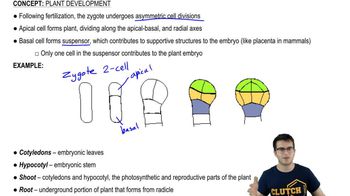
Embryonic Development

After fertilization, the zygote undergoes a series of divisions and transformations, leading to the formation of an embryo. This stage involves critical processes such as cleavage, gastrulation, and organogenesis, where the basic body plan and organ systems are established. Understanding embryonic development is essential for comprehending how a single fertilized egg develops into a complex organism.
Recommended video:
Guided course
06:02
Embryonic Plant Development