Pearson+ LogoPearson+ Logo
Ch. 4 - Body Weight and Health
Belk, Maier - Biology: Science for Life 6th Edition
Belk, Maier6th EditionBiology: Science for LifeISBN: 9780135214084Not the one you use?Change textbook
Chapter 4, Problem 2

Add labels to the figure that follows, which illustrates the breakdown of a disaccharide inside a cell. Illustration of disaccharide breakdown in a cell, with labels for components.

Verified step by step guidance
1
Identify the disaccharide structure at the top of the image. It consists of two hexagonal rings connected by a bond, representing two monosaccharides linked together.
Label the two hexagonal rings as monosaccharides, which are the building blocks of disaccharides.
Label the bond between the two monosaccharides as a glycosidic bond, which is the type of bond that connects monosaccharides in a disaccharide.
Identify the green structure below the disaccharide as an enzyme, which facilitates the breakdown of the disaccharide.
Label the enzyme with its specific name, such as sucrase or lactase, depending on the type of disaccharide being broken down.

Verified video answer for a similar problem:

This video solution was recommended by our tutors as helpful for the problem above.
Video duration:
2m
Was this helpful?

Key Concepts

Here are the essential concepts you must grasp in order to answer the question correctly.

Disaccharides

Disaccharides are carbohydrates formed by the combination of two monosaccharides through a glycosidic bond. Common examples include sucrose (glucose + fructose) and lactose (glucose + galactose). Understanding their structure and how they break down is essential for grasping cellular metabolism and energy production.
Recommended video:
Guided course
03:08
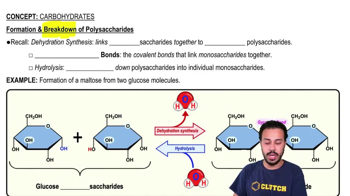
Formation & Breakdown of Polysaccharides

Enzymatic Breakdown

The breakdown of disaccharides in cells is facilitated by specific enzymes, such as sucrase and lactase. These enzymes catalyze the hydrolysis reaction, which splits the disaccharide into its constituent monosaccharides, making them available for cellular processes. This enzymatic action is crucial for digestion and energy release.
Recommended video:
Guided course
03:08
Formation & Breakdown of Polysaccharides

Cellular Metabolism

Cellular metabolism encompasses all biochemical reactions occurring within a cell, including the breakdown of carbohydrates for energy. The products of disaccharide breakdown, the monosaccharides, enter metabolic pathways like glycolysis, where they are further processed to generate ATP, the energy currency of the cell.