Pearson+ LogoPearson+ Logo
Ch. 15 - Is the Human Population Too Large?
Belk, Maier - Biology: Science for Life 6th Edition
Belk, Maier6th EditionBiology: Science for LifeISBN: 9780135214084Not the one you use?Change textbook
Chapter 15, Problem 4

A population growing exponentially
a. Is stable in size
b. Adds a fixed number of individuals every generation
c. Adds a larger number of individuals in each successive generation
d. Will likely expand forever
e. Will not crash

Verified step by step guidance
1
Understand the concept of exponential growth: Exponential growth occurs when the growth rate of a population is proportional to its current size. This means the population grows faster as it becomes larger, rather than adding a fixed number of individuals each generation.
Analyze the options provided: Evaluate each option to determine which one aligns with the characteristics of exponential growth. For example, consider whether the population size remains stable, grows by a fixed number, or increases by a larger number in successive generations.
Recall the mathematical representation of exponential growth: The formula for exponential growth is typically expressed as \( N_t = N_0 e^{rt} \), where \( N_t \) is the population size at time \( t \), \( N_0 \) is the initial population size, \( r \) is the growth rate, and \( e \) is the base of the natural logarithm. This formula shows that the population grows multiplicatively, not additively.
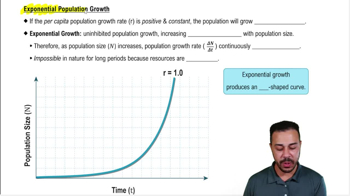
Focus on the key characteristic of exponential growth: Exponential growth results in the addition of a larger number of individuals in each successive generation because the growth rate applies to the increasing population size.
Select the correct answer: Based on the analysis, identify the option that best describes exponential growth. In this case, the correct answer is the one that states the population adds a larger number of individuals in each successive generation.

Verified video answer for a similar problem:

This video solution was recommended by our tutors as helpful for the problem above.
Video duration:
1m
Was this helpful?

Key Concepts

Here are the essential concepts you must grasp in order to answer the question correctly.

Exponential Growth

Exponential growth occurs when a population increases by a constant percentage over a specific time period, leading to a rapid increase in size. This type of growth is characterized by a J-shaped curve when graphed, indicating that the population size accelerates as it grows. In ideal conditions, such as unlimited resources, populations can grow exponentially until they reach environmental limits.
Recommended video:
Guided course
03:05
Exponential Population Growth

Carrying Capacity

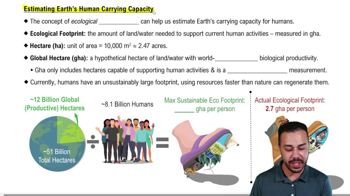
Carrying capacity refers to the maximum number of individuals that an environment can sustainably support without degrading the habitat. As populations grow exponentially, they may eventually approach this limit, leading to resource depletion and increased competition. Understanding carrying capacity is crucial for predicting population dynamics and potential crashes.
Recommended video:
Guided course
06:24
Estimating Earth’s Human Carrying Capacity

Population Dynamics

Population dynamics is the study of how and why populations change over time, influenced by factors such as birth rates, death rates, immigration, and emigration. It encompasses various growth models, including exponential and logistic growth, and helps explain phenomena like population crashes and recovery. Analyzing these dynamics is essential for managing wildlife and understanding ecological balance.
Recommended video:
Guided course
03:01
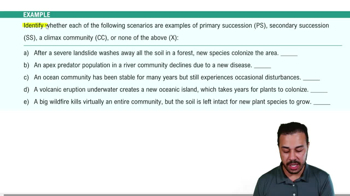
Community Dynamics Example 1