Pearson+ LogoPearson+ Logo
Ch. 12 - An Evolving Enemy
Belk, Maier - Biology: Science for Life 6th Edition
Belk, Maier6th EditionBiology: Science for LifeISBN: 9780135214084Not the one you use?Change textbook
Chapter 12, Problem 9

Ivory from elephant tusks is a valuable commodity on the world market. As a result, male African elephants with large tusks have been heavily hunted for the past few centuries. Today, male elephants have significantly shorter tusks at full adulthood than male elephants in the early 1900s. This is an example of:
a. Diversifying selection
b. Stabilizing selection
c. Directional selection
d. Chance
e. More than one of the above is correct

Verified step by step guidance
1
Step 1: Begin by understanding the concept of natural selection and how it can influence traits in a population over time. Natural selection occurs when certain traits provide a survival or reproductive advantage, leading to their increased prevalence in future generations.
Step 2: Review the definitions of the types of selection mentioned in the problem: - Diversifying selection favors extreme traits at both ends of the spectrum, leading to increased variation. - Stabilizing selection favors intermediate traits, reducing variation. - Directional selection favors one extreme trait, causing a shift in the population's traits over time.
Step 3: Analyze the scenario provided. Male elephants with large tusks have been heavily hunted, which reduces their survival and reproductive success. This creates selective pressure against large tusks, favoring elephants with shorter tusks.
Step 4: Determine which type of selection best fits the scenario. Since the population is shifting toward shorter tusks over time, this is an example of directional selection, where one extreme trait (shorter tusks) becomes more common due to selective pressure.
Step 5: Conclude that the correct answer is c. directional selection, as the population is evolving in a specific direction due to human-induced selective pressure.

Verified video answer for a similar problem:

This video solution was recommended by our tutors as helpful for the problem above.
Video duration:
4m
Was this helpful?

Key Concepts

Here are the essential concepts you must grasp in order to answer the question correctly.

Natural Selection

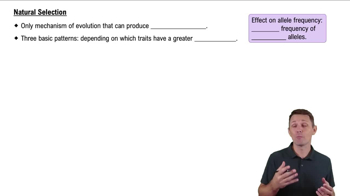
Natural selection is a fundamental mechanism of evolution, where individuals with traits better suited to their environment tend to survive and reproduce more than those with less advantageous traits. This process leads to changes in the traits of populations over generations, as advantageous traits become more common.
Recommended video:
04:43
Natural Selection

Directional Selection

Directional selection occurs when individuals with a particular trait at one extreme of a phenotypic range have a higher fitness than those at the other extreme. In the context of the elephant tusks, the hunting of males with larger tusks has favored shorter tusks over time, illustrating how human activity can influence evolutionary outcomes.
Recommended video:
04:43
Natural Selection

Phenotypic Variation

Phenotypic variation refers to the differences in physical traits among individuals in a population, which can be influenced by genetic and environmental factors. In the case of elephants, the variation in tusk length is a phenotypic trait that has been affected by selective pressures from hunting, leading to observable changes in the population's characteristics.
Recommended video:
Guided course
06:36
Genotype & Phenotype