Pearson+ LogoPearson+ Logo
Ch. 1 - Can Science Cure the Common Cold?
Belk, Maier - Biology: Science for Life 6th Edition
Belk, Maier6th EditionBiology: Science for LifeISBN: 9780135214084Not the one you use?Change textbook
Chapter 1, Problem 6

If I perform a hypothesis test in which I demonstrate that the prediction I made in question 5 is true, I have ________.
a. Proved the hypothesis
b. Supported the hypothesis
c. Not falsified the hypothesis
d. B and C are correct
e. A, B, and C are correct

Verified step by step guidance
1
Understand the nature of a hypothesis in scientific research: A hypothesis is a testable statement or prediction that can be supported or refuted through experimentation or observation. It is not 'proven' in the absolute sense, as science is always open to new evidence.
Clarify the meaning of 'supporting' a hypothesis: When experimental results align with the prediction made by the hypothesis, the hypothesis is considered supported. This means the evidence is consistent with the hypothesis but does not prove it definitively.
Clarify the meaning of 'not falsified': In science, a hypothesis is considered 'not falsified' if the experimental results do not contradict it. This is a key principle in the scientific method, as hypotheses must be falsifiable to be scientifically valid.
Evaluate the options provided: Option A ('proved the hypothesis') is incorrect because scientific hypotheses are not proven in an absolute sense. Option B ('supported the hypothesis') and Option C ('not falsified the hypothesis') are correct because the results align with the hypothesis and do not contradict it.
Conclude that the correct answer is Option D ('B and C are correct'), as both supporting the hypothesis and not falsifying it are valid outcomes of the experiment.

Verified video answer for a similar problem:

This video solution was recommended by our tutors as helpful for the problem above.
Video duration:
44s
Was this helpful?

Key Concepts

Here are the essential concepts you must grasp in order to answer the question correctly.

Hypothesis Testing

Hypothesis testing is a statistical method used to make inferences or draw conclusions about a population based on sample data. It involves formulating a null hypothesis (H0) and an alternative hypothesis (H1), then using data to determine whether to reject H0. The outcome indicates whether there is enough evidence to support H1, but it does not prove the hypothesis definitively.
Recommended video:

Supporting vs. Proving a Hypothesis

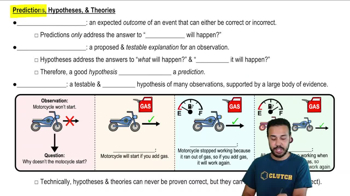
Supporting a hypothesis means that the evidence gathered aligns with the predictions made, suggesting that the hypothesis is plausible. However, proving a hypothesis implies absolute certainty, which is not achievable in scientific research. Instead, hypotheses can only be supported or not falsified based on the results of the tests conducted.
Recommended video:
Guided course
08:22
Predictions, Hypotheses, & Theories

Falsifiability

Falsifiability is a key principle in scientific inquiry, indicating that a hypothesis must be testable and capable of being proven false. If a hypothesis cannot be disproven through experimentation or observation, it lacks scientific validity. In the context of hypothesis testing, failing to falsify a hypothesis means that the evidence does not contradict it, but does not confirm it as true.
Recommended video:
Guided course
08:22
Predictions, Hypotheses, & Theories
Related Practice
Textbook Question

A scientific hypothesis is ________.

a. An opinion

b. A proposed explanation for an observation

c. A fact

d. Easily proved true

e. An idea proposed by a scientist

14
views
Textbook Question

How is a scientific theory different from a scientific hypothesis?

a. It is based on weaker evidence

b. It has not been proved true

c. It is not falsifiable

d. It can explain a large number of observations

e. It must be proposed by a professional scientist

4
views
Textbook Question

One hypothesis states that eating chicken noodle soup is an effective treatment for colds. Which of the following results does this hypothesis predict?

a. People who eat chicken noodle soup have shorter colds than do people who do not eat chicken noodle soup.

b. People who do not eat chicken noodle soup experience unusually long and severe colds.

c. Cold viruses cannot live in chicken noodle soup.

d. People who eat chicken noodle soup feel healthier than do people who do not eat chicken noodle soup.

e. Consuming chicken noodle soup causes people to sneeze.

3
views
Textbook Question

Control subjects in an experiment _________.

a. Should be similar in most ways to the experimental subjects.

b. Should not know whether they are in the control or experimental group.

c. Should have essentially the same interactions with the researchers as the experimental subjects.

d. Help eliminate alternative hypotheses that could explain experimental results.

e. All of the above.

6
views
Textbook Question

An experiment in which neither the participants in the experiment nor the technicians collecting the data know which individuals are in the experimental group and which ones are in the control group is known as _________.

a. Controlled

b. Biased

c. Double-blind

d. Falsifiable

e. Unpredictable

6
views
Textbook Question

A relationship between two factors, for instance, between outside temperature and the number of people with active colds in a population, is known as a(n) ________.

a. Significant result

b. Correlation

c. Hypothesis

d. Alternative hypothesis

e. Experimental test

4
views